How Are Ancesrtal Spirits Passed on to Family Member Upon Death
The veneration of the expressionless, including i's ancestors, is based on dearest and respect for the deceased. In some cultures, it is related to beliefs that the dead have a continued existence, and may possess the ability to influence the fortune of the living. Some groups venerate their directly, familial ancestors. Certain sects and religions, in item the Eastern Orthodox Church and Roman Catholic Church building, venerate saints as intercessors with God; the latter also believes in prayer for departed souls in Purgatory. Other religious groups, nonetheless, consider veneration of the dead to be idolatry and a sin.
In European, Asian, Oceanian, African and Afro-diasporic cultures, the goal of ancestor veneration is to ensure the ancestors' connected well-beingness and positive disposition towards the living, and sometimes to ask for special favours or assistance. The social or non-religious function of ancestor veneration is to cultivate kinship values, such equally filial piety, family unit loyalty, and continuity of the family unit lineage. Antecedent veneration occurs in societies with every degree of social, political, and technological complexity, and information technology remains an important component of various religious practices in modern times.
Overview [edit]
Ancestor reverence is not the same as the worship of a deity or deities. In some Afro-diasporic cultures, ancestors are seen as existence able to intercede on behalf of the living, often as messengers between humans and God. Every bit spirits who were once human themselves, they are seen as being ameliorate able to empathise human being needs than would a divine being. In other cultures, the purpose of ancestor veneration is not to enquire for favors but to exercise one's filial duty. Some cultures believe that their ancestors actually need to be provided for past their descendants, and their practices include offerings of food and other provisions. Others do not believe that the ancestors are even aware of what their descendants exercise for them, only that the expression of filial piety is what is important.
Most cultures who practice ancestor veneration practice non phone call it "ancestor worship". In English, the word worship usually merely non always refers to the reverent dearest and devotion accorded a deity (god) or God.[one] [2] [three] Nevertheless, in other cultures, this act of worship does not confer whatsoever belief that the departed ancestors accept become some kind of deity. Rather, the act is a way to limited filial duty, devotion and respect and look after ancestors in their afterlives also as seek their guidance for their living descendants. In this regard, many cultures and religions have similar practices. Some may visit the graves of their parents or other ancestors, go out flowers and pray to them in guild to honor and remember them, while also asking their ancestors to go on to look after them. Withal, this would non be considered equally worshiping them since the term worship may not e'er convey such meaning in the exclusive and narrow context of certain Western European Christian traditions.
In that sense the phrase antecedent veneration may simply from the express perspective of certain Western European Christian traditions, convey a more accurate sense of what practitioners, such as the Chinese and other Buddhist-influenced and Confucian-influenced societies, besides as the African and European cultures see themselves as doing. This is consistent with the meaning of the discussion veneration in English, that is great respect or reverence acquired by the dignity, wisdom, or dedication of a person.[4] [5] [half dozen]
Although there is no generally accepted theory apropos the origins of ancestor veneration, this social phenomenon appears in some class in all human cultures documented and then far. David-Barrett and Carney claim that ancestor veneration might have served a grouping coordination part during human development,[vii] and thus it was the mechanism that led to religious representation fostering group cohesion.[eight] [9]
West and Southeast African cultures [edit]
Ancestor veneration is prevalent throughout Africa, and serves equally the basis of many religions. Information technology is often augmented past a belief in a supreme being, but prayers and/or sacrifices are usually offered to the ancestors who may arise to condign a kind of minor deities themselves. Ancestor veneration remains among many Africans, sometimes practiced alongside the later adopted religions of Christianity (as in Nigeria among the Igbo people), and Islam (amongst the different Mandé peoples and the Bamum and the Bakossi people) in much of the continent.[x] [11] In orthodox Serer religion, the pangool is venerated by the Serer people.
Serer of Senegal and Republic of the gambia [edit]
The Seereer people of Senegal, The Gambia and Islamic republic of mauritania who adhere to the tenets of A ƭat Roog (Seereer religion) believe in the veneration of the pangool (ancient Seereer saints and/or ancestral spirits). There are various types of pangool (singular: fangol), each with its ain means of veneration.
Madagascar [edit]

Veneration of ancestors is prevalent throughout the isle of Madagascar. Approximately one-half of the land'southward population of 20 million currently practice traditional faith,[12] which tends to emphasize links between the living and the razana (ancestors). The veneration of ancestors has led to the widespread tradition of tomb building, as well as the highlands practice of the famadihana, whereby a deceased family fellow member'south remains may be exhumed to be periodically re-wrapped in fresh silk shrouds before being replaced in the tomb. The famadihana is an occasion to celebrate the dear ancestor's memory, reunite with family and customs, and enjoy a festive temper. Residents of surrounding villages are often invited to attend the political party, where food and rum are typically served and a hiragasy troupe or other musical amusement is normally present.[13] Veneration of ancestors is also demonstrated through adherence to fady, taboos that are respected during and after the lifetime of the person who establishes them. It is widely believed that past showing respect for ancestors in these means, they may intervene on behalf of the living. Conversely, misfortunes are often attributed to ancestors whose retention or wishes have been neglected. The cede of zebu is a traditional method used to appease or honor the ancestors. Small, everyday gestures of respect include throwing the get-go capful of a newly opened bottle of rum into the northeast corner of the room to give the ancestors their due share.[xiv]
Asian cultures [edit]
Cambodia [edit]
During Pchum Ben and the Cambodian New year's day people make offerings to their ancestors. Pchum Ben is a time when many Cambodians pay their respects to deceased relatives of up to seven generations.[15] Monks dirge the suttas in Pali language overnight (continuously, without sleeping) in prelude to the gates of hell opening, an effect that is presumed to occur once a yr, and is linked to the cosmology of Rex Yama originating in the Pali Canon. During this catamenia, the gates of hell are opened and ghosts of the expressionless (preta) are presumed to be peculiarly active. In club to combat this, nutrient-offerings are fabricated to benefit them, some of these ghosts having the opportunity to finish their period of purgation, whereas others are imagined to get out hell temporarily, to then render to endure more than suffering; without much explanation, relatives who are not in hell (who are in heaven or otherwise reincarnated) are also by and large imagined to benefit from the ceremonies.
China [edit]

In People's republic of china, ancestor veneration (敬祖, pinyin: jìngzǔ) and ancestor worship (拜祖, pinyin: bàizǔ) seek to award and recollect the deportment of the deceased; they represent the ultimate homage to the expressionless. The importance of paying respect to parents (and elders) lies with the fact that all physical actual aspects of one's being were created past ane'southward parents, who continued to tend to ane'southward well-being until one was on business firm basis. The respect and homage to parents is to return this gracious deed to them in life and afterward. The shi (尸; "corpse, personator") was a Zhou dynasty (1045–256 BCE) sacrificial representative of a dead relative. During a shi ceremony, the bequeathed spirit supposedly would enter the personator, who would swallow and drink sacrificial offerings and convey spiritual messages.
Sacrifices [edit]

In traditional Chinese civilisation, sacrifices are sometimes fabricated to altars as nutrient for the deceased. This falls under the modes of communication with the Chinese spiritual globe concepts. Some of the veneration includes visiting the deceased at their graves, and making or ownership offerings for the deceased in the Spring, Autumn, and Ghost Festivals. Due to the hardships of the belatedly 19th- and 20th-century Prc, when meat and poultry were difficult to come past, sumptuous feasts are still offered in some Asian countries as a practise to the spirits or ancestors. Withal, in the orthodox Taoist and Buddhist rituals, but vegetarian nutrient would suffice. For those with deceased in the afterlife or hell, elaborate or even creative offerings, such as servants, refrigerators, houses, motorcar, paper money and shoes are provided then that the deceased volition exist able to have these items after they accept died. Often, paper versions of these objects are burned for the aforementioned purpose. Originally, existent-life objects were cached with the dead. In time these appurtenances were replaced by total size clay models which in turn were replaced past scale models, and in time today's paper offerings (including paper servants).
Bharat [edit]

Ancestors are widely revered, honoured, and venerated in India and Cathay. The spirit of a dead person is called Pitrs, which is venerated. When a person dies, the family observes a 13-solar day mourning period, generally called śrāddha. A year thence, they detect the ritual of Tarpan, in which the family unit makes offerings to the deceased. During these rituals, the family prepares the food items that the deceased liked and offers food to the deceased. They offer this food to crows as well on certain days as it is believed that the soul comes in the form of a bird to taste information technology. They are also obliged to offering śrāddha, a small feast of specific preparations, to eligible Brahmins. Only after these rituals are the family members allowed to swallow. Information technology is believed that this reminds the antecedent's spirits that they are not forgotten and are loved, and so it brings them peace. On Shradh days, people pray that the souls of ancestors be appeased, forget any animosity and find peace. Each year, on the particular date (equally per the Hindu calendar) when the person had died, the family members repeat this ritual.
Indian and Chinese practices of ancestor-worship are prevalent throughout Asia every bit a result of the large Indian and Chinese populations in countries such as Singapore, Malaysia, Republic of indonesia, and elsewhere beyond the continent. Furthermore, the large Indian population in places such as Fiji and Guyana has resulted in these practices spreading beyond their Asian homeland.
Assam [edit]

Mae Dam Mae Phi celebrations in Assam, Republic of india.
The Ahom religion is based on ancestor-worship. The Ahoms believe that a man later his death remains equally 'Dam'(ancestor) simply for a few days and before long he becomes 'Phi' (God). They also believe that the soul of a human being which is immortal unites with the supreme soul, possesses the qualities of a spiritual existence and always blesses the family unit. And so every Ahom family in order to worship the dead constitute a pillar on the reverse side of the kitchen (Barghar) which is called 'Damkhuta' where they worship the dead with various offerings like homemade wine, mah-prasad, rice with various items of meat and fish. Me-Dam-Me-Phi, a ritual centred on commemorating the expressionless, is celebrated by the Ahom people on 31 January every twelvemonth in retentivity of the departed. It is the manifestation of the concept of ancestor worship that the Ahoms share with other peoples originating from the Tai-Shan stock. It is a festival to prove respect to the departed ancestors and retrieve their contribution to society. On the day of Me-Dam Me Phi worship is offered just to Chaufi and Dam Chaufi considering they are regarded as gods of heaven.
Indus Valley Civilisation [edit]
At Rakhigarhi, an Indus Valley Civilization (IVC) site in Haryana, the lover's skeletons of a homo between 35 and forty years old and women in early on 20s were found who were likely married to each other and cached together, their grave independent pots which likely carried food and water equally offering to the dead.[16] [17]
Paliya in Gujarat [edit]

Iv Paliyas, one dedicated to human and three to women at Chhatardi, Bhuj, Kutch, Gujarat, Republic of india
The Paliya memorial stones are associated with ancestral worship in western Republic of india. These memorials are worshiped by people of associated community or decedents of a person on special days such as decease mean solar day of person, effect anniversaries, festivals, auspicious days in Kartika, Shraavana or Bhadrapada months of Hindu calendar. These memorials are washed with milk and h2o on these days. They are smeared with sindoor or kumkum and flowers are scattered over it. The earthen lamp is lighted near information technology with sesame oil. Sometimes a flag is erected over information technology.[18]
Pitru Paksha in Indian-origin religions [edit]
Apart from this, there is also a fortnight-long duration each yr called Pitru Paksha ("fortnight of ancestors"), when the family remembers all its ancestors and offers "Tarpan" to them.[19] This flow falls just before the Navratri or Durga Puja falling in the calendar month of Ashwin. Mahalaya marks the end of the fortnight-long Tarpan to the ancestors.[20]
Tuluva Culture in Tulu Nadu [edit]
Tuluvas have the ancestor worship in the proper name of Buta Kola.
Republic of indonesia [edit]
In Republic of indonesia antecedent worship has been a tradition of some of the ethnic people. Podom of the Toba Batak, Waruga of the Minahasans and the coffins of the Karo people (Indonesia) are a few examples of the forms the veneration takes.
Japan [edit]
Before the introduction of Buddhism to Japan, ancestor worship and funerary rites were not common, especially for non-elites.[21] In the Heian Menstruum, abandonment was a mutual method of disposing of the expressionless.[22] Following the appearance of Buddhism, rituals were sometimes performed at the gravesite after burial or cremation.[23]
Korea [edit]

A Korean jesa altar for ancestors
In Korea, antecedent veneration is referred to past the generic term jerye (hangul: 제례; hanja: 祭禮) or jesa (hangul: 제사; hanja: 祭祀). Notable examples of jerye include Munmyo jerye and Jongmyo jerye, which are performed periodically each year for venerated Confucian scholars and kings of ancient times, respectively. The ceremony held on the ceremony of a family unit member'southward decease is called charye (차례). Information technology is still adept today.[24]
The majority of Catholics, Buddhists and nonbelievers practice ancestral rites, although Protestants do not.[25] The Cosmic ban on bequeathed rituals was lifted in 1939, when the Catholic Church building formally recognized ancestral rites as a ceremonious practice.[25]
Ancestral rites are typically divided into three categories:[26]
- Charye (차례, 茶禮) – tea rites held 4 times a year on major holidays (Korean New year, Chuseok)
- Kije (기제, 忌祭) – household rites held the night before an ancestor's death anniversary (기일, 忌日)
- Sije (시제, 時祭; too called 사시제 or 四時祭) – seasonal rites held for ancestors who are v or more generations removed (typically performed annually on the tenth lunar calendar month)
Myanmar [edit]
Ancestor worship in modern-day Myanmar is largely confined to some ethnic minority communities, but mainstream remnants of it still exist, such equally worship of Bo Bo Gyi (literally "corking grandad"), as well as of other guardian spirits such equally nats, all of which may be vestiges of historic ancestor worship.[27]
Ancestor worship was present in the regal court in pre-colonial Burma. During the Konbaung dynasty, solid gold images of deceased kings and their consorts were worshiped three times a year past the royal family, during the Burmese New Year (Thingyan), at the beginning and at the cease of Vassa.[28] The images were stored in the treasury and worshiped at the Zetawunzaung ( ဇေတဝန်ဆောင် , "Hall of Ancestors"), along with a book of odes.[28]
Some scholars attribute the disappearance of antecedent worship to the influence of Buddhist doctrines of anicca and anatta, impermanence and rejection of a 'cocky'.[29]
Philippines [edit]

In the animistic indigenous religions of the precolonial Philippines, antecedent spirits were one of the two major types of spirits (anito) with whom shamans communicate. Antecedent spirits were known as umalagad (lit. "guardian" or "caretaker"). They can be the spirits of actual ancestors or generalized guardian spirits of a family. Ancient Filipinos believed that upon expiry, the soul of a person travels (unremarkably by boat) to a spirit world.[30] [31] [32] In that location can be multiple locations in the spirit world, varying in different ethnic groups. Which place souls end upward in depends on how they died, the age at death, or conduct of the person when they were live. Souls reunite with deceased relatives in the underworld and atomic number 82 normal lives in the underworld equally they did in the material world. In some cases, the souls of evil people undergo penance and cleansing before they are granted entrance into a particular spirit realm. Souls would eventually reincarnate after a menstruation of time in the spirit world.[30] [31] [33] [34]
Souls in the spirit world still retain a degree of influence in the material world, and vice versa. Paganito rituals may be used to invoke adept ancestor spirits for protection, intercession, or advice. Vengeful spirits of the dead tin manifest as apparitions or ghosts (mantiw) and cause impairment to living people. Paganito can be used to appease or blackball them.[thirty] [33] [35] Ancestor spirits besides figured prominently during illness or death, every bit they were believed to be the ones who call the soul to the underworld, guide the soul (a psychopomp), or meet the soul upon arrival.[30]
Ancestor spirits are likewise known as kalading among the Cordillerans;[36] tonong among the Maguindanao and Maranao;[37] umboh among the Sama-Bajau;[38] ninunò among Tagalogs; and nono among Bicolanos.[39] Ancestor spirits are unremarkably represented by carved figures called taotao. These were carved by the customs upon a person'due south expiry. Every household had a taotao stored in a shelf in the corner of the firm.[30]
The predominantly Roman Catholic Filipino people still hold ancestors in particular esteem—though without the formality common to their neighbours—despite having been Christianised since coming into contact with Spanish missionaries in 1521. In the present day, antecedent veneration is expressed in having photographs of the expressionless by the dwelling altar, a mutual fixture in many Filipino Christian homes. Candles are often kept burning before the photographs, which are sometimes decorated with garlands of fresh sampaguita, the national blossom. Ancestors, particularly dead parents, are even so regarded equally psychopomps, as a dying person is said to be brought to the afterlife (Tagalog: sundô, "fetch") by the spirits of dead relatives. It is said that when the dying call out the names of deceased loved ones, they can run into the spirits of those particular people waiting at the foot of the deathbed.[ citation needed ]
Filipino Catholic and Aglipayan veneration of the dead finds its greatest expression in the Philippines is the Hallowmas season betwixt 31 October and 2 November, variously called Undás (based on the word for "[the] first", the Castilian andas or maybe honra), Todos los Santos (literally "All Saints"), and sometimes Áraw ng mga Patáy (lit. "24-hour interval of the Dead"), which refers to the following solemnity of All Souls' Mean solar day. Filipinos traditionally notice this solar day past visiting the family expressionless, cleaning and repairing their tombs. Common offerings are prayers, flowers, candles, and fifty-fifty food, while many also spend the remainder of the day and ensuing dark holding reunions at the graveyard, playing games and music or singing.[ citation needed ]
Chinese Filipinos, meanwhile, accept the near apparent and distinct customs related to ancestor veneration, carried over from traditional Chinese religion and most often melded with their current Catholic organized religion. Many notwithstanding fire incense and kim at family tombs and earlier photos at habitation, while they incorporate Chinese practises into Masses held during the All Souls' Twenty-four hour period menses.[ citation needed ]
Sri Lanka [edit]
In Sri Lanka, making offerings to one'south ancestors is conducted on the sixth twenty-four hours after expiry as a role of traditional Sri Lankan funeral rites.[forty]
Thailand [edit]
In rural northern Thailand, a religious ceremony honoring bequeathed spirits known as Faun Phii (Thai: ฟ้อนผี, lit. "spirit dance" or "ghost trip the light fantastic toe") takes place. It includes offerings for ancestors with spirit mediums sword fighting, spirit-possessed dancing, and spirit mediums cock fighting in a spiritual cockfight.[41]
Vietnam [edit]

A Vietnamese altar for ancestors. Note smaller Buddhist chantry gear up college in the upper corner
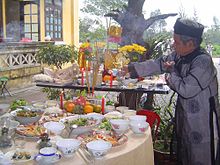
An old human in traditional dress on the occasion of New Year offering
Ancestor veneration is 1 of the most unifying aspects of Vietnamese culture, equally practically all Vietnamese, regardless of religious affiliation (Buddhist, Catholic or animist) have an ancestor chantry in their home or business.
In Vietnam, traditionally people did not celebrate birthdays (before Western influence), just the death anniversary of one's loved one was ever an important occasion. Besides an essential gathering of family unit members for a banquet in memory of the deceased, incense sticks are burned along with hell notes, and great platters of food are made as offerings on the ancestor chantry, which normally has pictures or plaques with the names of the deceased. In the case of missing persons, believed to be dead by their family, a Wind tomb is made.
These offerings and practices are done ofttimes during important traditional or religious celebrations, the starting of a new business, or even when a family member needs guidance or counsel and is a hallmark of the emphasis Vietnamese culture places on filial duty.
A significant distinguishing feature of Vietnamese ancestor veneration is that women take traditionally been allowed to participate and co-officiate ancestral rites, unlike in Chinese Confucian doctrine, which allows merely male descendants to perform such rites.[42]
European cultures [edit]

In Catholic countries in Europe (continued later with the Anglican Church in England), November 1 (All Saints' Solar day), became known and is still known as the day to specifically venerate those who have died, and who have been deemed official saints by the Church. November two, (All Souls Day), or "The Twenty-four hour period of the Dead", is the day when all of the faithful dead are remembered. On that day, families go to cemeteries to light candles for their dead relatives, leave them flowers, and often to picnic. The evening before All Saints'—"All Hallows Eve" or "Hallowe'en"—is unofficially the Catholic day to remember the realities of Hell, to mourn the souls lost to evil, and to think means to avoid Hell[ citation needed ]. Information technology is commonly celebrated in the Usa and parts of the United kingdom in a spirit of low-cal-hearted horror and fearfulness, which is marked by the recounting of ghost stories, bonfires, wearing costumes, carving jack-o'-lanterns, and "trick-or-treating" (going door to door and begging for candy).
Brythonic Celtic cultures [edit]
In Cornwall and Wales, the autumn ancestor festivals occur around Nov. one. In Cornwall the festival is known equally Kalan Gwav, and in Wales as Calan Gaeaf. [43] The festivals are from which modern Halloween is derived.[43]
Gaelic Celtic cultures [edit]
During Samhain, November 1 in Ireland and Scotland, the dead are thought to return to the earth of the living, and offerings of nutrient and light are left for them.[44] On the festival day, aboriginal people would extinguish the hearth fires in their homes, participate in a customs bonfire festival, so carry a flame home from the communal fire and use it calorie-free their home fires anew.[45] This custom has connected to some extent into mod times, in both the Celtic nations and the diaspora.[46] Lights in the window to guide the dead home are left burning all night.[44] On the Mann the festival is known as "onetime Sauin" or Hop-tu-Naa.[47]
North America [edit]
In the U.s.a. and Canada, flowers, wreaths, grave decorations and sometimes candles, food, small pebbles, or items the dead valued in life are put on graves year-round as a manner to honor the expressionless. These traditions originate in the diverse cultural backgrounds of the electric current populations of both countries. In the The states, many people honour deceased loved ones who were in the war machine on Memorial Day. Days with religious and spiritual significance like Easter, Christmas, Candlemas, and All Souls' Twenty-four hour period, Twenty-four hours of the Dead, or Samhain are besides times when relatives and friends of the deceased may gather at the graves of their loved ones. In the Catholic Church, one's local parish church often offers prayers for the dead on their death anniversary or All Souls' Day.
In the United States, Memorial Day is a Federal vacation for remembering the deceased men and women who served in the nation'due south military, particularly those who died in state of war or during agile service. In the 147 National Cemeteries, like Arlington and Gettysburg, it is common for volunteers to place small American flags at each grave. Memorial Solar day is traditionally observed on the final Monday in May, allotting for a iii-solar day weekend in which many memorial services and parades take place not only across the country, but in 26 American cemeteries on foreign soil (in French republic, Belgium, the United kingdom, the Philippines, Panama, Italia, Luxembourg, United mexican states, Netherlands, and Tunisia). It is also common practise among veterans to memorialize fallen service members on the dates of their decease. This practise is also common in other countries when remembering Americans who died in battles to liberate their towns in the World Wars. One example of this is on 16 August (1944) Colonel Griffith, died of wounds from enemy action sustained in Lèves, the same twenty-four hour period he is credited with saving Chartres Cathedral from destruction.
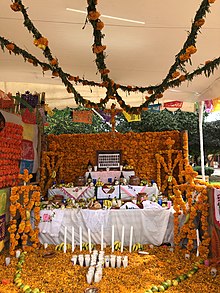
In Judaism, when a grave site is visited, a minor pebble is placed on the headstone. While there is no clear respond as to why, this custom of leaving pebbles may date back to biblical days when individuals were buried under piles of stones. Today, they are left as tokens that people take been there to visit and to recall.[48]
Americans of various religions and cultures may build a shrine in their habitation defended to loved ones who take died, with pictures of their ancestors, flowers and mementos. Increasingly, many roadside shrines may be seen for deceased relatives who died in car accidents or were killed on that spot, sometimes financed by the state or province as these markers serve equally potent reminders to bulldoze cautiously in hazardous areas. The Vietnam Veterans Memorial in Washington, D.C., is peculiarly known for the leaving of offerings to the deceased; items left are collected by the National Park Service and archived.
Members of The Church of Jesus Christ of Latter-day Saints perform posthumous baptisms and other rituals for their dead ancestors, along with those of other families.
Native Americans were non heavily concerned with the veneration of the dead, though they were known to bury the dead with clothes and tools likewise as occasionally leave food and drink at the gravesite; Pueblo Indians supported a cult of the dead which worshipped or petitioned the expressionless through ritualistic dances.[49]
Islam [edit]
Islam has a complex and mixed view on the idea of grave shrines and ancestor worship. The graves of many early Islamic figures are holy sites for Muslims, including Ali, and a cemetery with many companions and early on caliphs. Many other mausoleums are major architectural, political, and cultural sites, including the National Mausoleum in Pakistan and the Taj Mahal in India. However, the religious movement of Wahhabism disputes the concept of saint veneration.[50] Followers of this movement take destroyed many gravesite shrines, including in Kingdom of saudi arabia and in territory controlled by the Islamic State, though information technology was the teaching of prophet[ who? ] to visit graves and practice of followers to visit the holy shrine of prophet and supplicate at that place.
Iman Ahmad, Al-Hakim, and others narrated about Marwan Ibn al-Hakam–an unjust ruler–that he once passed past the grave of the Prophet and saw a man with his cheek on the grave of the Prophet. Marwan Ibn al-Hakam asked: "Do you know what you are doing?" Nearing the grave, Marwan Ibn al-Hakam realized information technology was Abu Ayyub al-Ansariyy, i of the greatest companions of the Prophet. Abu Ayyub al-Ansariyy replied, "Yep, I know what I am doing. I came here for the Messenger of Allah–non for the stone." By this he meant he was seeking the blessings from the presence of the Prophet, not for the rock roofing his grave. Abu Ayyub al-Ansariyy continued his response with what he heard the Messenger of Allah say: "Do not cry over the Organized religion of Islam if the rulers are ruling correctly. Rather, cry over this Organized religion if the rulers are ruling incorrectly." By his response, Abu Ayyub was telling Marwan Ibn al-Hakam: "You are non ane of those rulers who are correctly ruling by the rules of Islam."
Some followers of Islam are at odds with the concept of saint veneration, merely this practise is retained in Turkey, especially through Alevi Muslims.[l]
Ancient cultures [edit]
Ancestor worship was a prominent characteristic of many historical societies.
Ancient Egypt [edit]
Although some historians merits that ancient Egyptian order was a "death cult" considering of its elaborate tombs and mummification rituals, it was the opposite. The philosophy that "this world is merely a vale of tears" and that to die and be with God is a ameliorate existence than an earthly one was relatively unknown amidst the ancient Egyptians. This was non to say that they were unacquainted with the harshness of life; rather, their ethos included a sense of continuity betwixt this life and the next. The Egyptian people loved the culture, customs and religion of their daily lives and then much that they wanted to continue them in the next—although some might hope for a better station in the Beautiful West (Egyptian afterlife).
Tombs were housing in the Hereafter then they were carefully constructed and busy, merely as homes for the living were. Mummification was a way to preserve the corpse and so the ka (soul) of the deceased could render to receive offerings of the things s/he enjoyed while live. If mummification was not affordable, a "ka-statue" in the likeness of the deceased was carved for this purpose. The Blessed Dead were collectively called the akhu, or "shining ones" (atypical: akh). They were described as "shining every bit gold in the abdomen of Nut" (Gr. Nuit) and were indeed depicted as golden stars on the roofs of many tombs and temples.
The process by which a ka became an akh was not automatic upon decease; it involved a lxx-day journeying through the duat, or Otherworld, which led to judgment earlier Wesir (Gr. Osiris), Lord of the Dead where the ka'due south center would be weighed on a scale against the Feather of Ma'at (representing Truth). However, if the ka was non properly prepared, this journey could exist fraught with dangerous pitfalls and strange demons; hence some of the earliest religious texts discovered, such as the Papyrus of Ani (usually known as The Book of the Dead) and the Pyramid Texts were actually written as guides to help the deceased successfully navigate the duat.
If the center was in balance with the Plume of Ma'at, the ka passed judgment and was granted admission to the Beautiful West as an akh who was ma'a heru ("truthful of voice") to dwell among the gods and other akhu. At this point only was the ka deemed worthy to be venerated by the living through rites and offerings. Those who became lost in the duat or deliberately tried to avoid judgment became the unfortunate (and sometimes unsafe) mutu, the Restless Expressionless. For the few whose truly evil hearts outweighed the Feather, the goddess Ammit waited patiently backside Wesir's judgment seat to consume them. She was a composite creature resembling three of the deadliest animals in Egypt: the crocodile, the hippopotamus and the lion. Existence fed to Ammit was to be consigned to the Eternal Void, to exist "unmade" as a ka.
Likewise being eaten by Ammit, the worst fate a ka could suffer afterwards physical death was to be forgotten. For this reason, ancestor veneration in ancient Arab republic of egypt was an important rite of remembrance in order to proceed the ka "alive" in this life as well equally in the next. Royals, nobles and the wealthy made contracts with their local priests to perform prayers and give offerings at their tombs. In return, the priests were allowed to keep a portion of the offerings as payment for services rendered. Some tomb inscriptions even invited passers-by to speak aloud the names of the deceased within (which also helped to perpetuate their retentivity), and to offer water, prayers or other things if they and so desired. In the private homes of the less wealthy, niches were carved into the walls for the purpose of housing images of familial akhu and to serve every bit altars of veneration.
Many of these same religious beliefs and antecedent veneration practices are still carried on today in the religion of Kemetic Orthodoxy.
Ancient Rome [edit]

The Romans, like many Mediterranean societies, regarded the bodies of the dead as polluting.[51] During Rome's Classical period, the body was most often cremated, and the ashes placed in a tomb outside the city walls. Much of the month of Feb was devoted to purifications, propitiation, and veneration of the dead, especially at the nine-day festival of the Parentalia during which a family honored its ancestors. The family visited the cemetery and shared block and wine, both in the class of offerings to the dead and as a repast among themselves. The Parentalia drew to a close on Feb 21 with the more somber Feralia, a public festival of sacrifices and offerings to the Manes, the potentially malevolent spirits of the dead who required propitiation.[52] One of the most common inscriptional phrases on Latin epitaphs is Dis Manibus, abbreviated D.Chiliad, "for the Manes gods", which appears even on some Christian tombstones. The Caristia on February 22 was a celebration of the family line equally it continued into the nowadays.[53]
A noble Roman family displayed ancestral images (imagines) in the tablinium of their home (domus). Some sources point these portraits were busts, while others suggest that funeral masks were also displayed. The masks, probably modeled of wax from the face of the deceased, were office of the funeral procession when an aristocracy Roman died. Professional mourners wore the masks and regalia of the expressionless person'southward ancestors as the torso was carried from the home, through the streets, and to its concluding resting place.[54]
Encounter also [edit]
- Anito
- Ásatrú
- Chinese ancestral worship
- Chinese ancestral hall & Ancestral tablet
- Chinese folk faith
- Chinese rites controversy
- Communion of saints
- Death ceremony
- Funerary art
- Funerary cult
- Haus Tambaran
- Ifá
- Molieben
- Bon Festival
- Qingming Festival
- Shamanism
- Transfer of merit
- Ullambana
- Zhong Yuan Festival
References [edit]
- ^ worship, Cambridge University Press
- ^ worship, Oxford Academy Press
- ^ worship, Merriam-Webster, Incorporated
- ^ venerate, Cambridge Academy Press
- ^ veneration, Oxford University Press
- ^ veneration, Merriam-Webster, Incorporated
- ^ Dávid-Barrett, Tamás; Carney, James (2015-08-14). "The deification of historical figures and the emergence of priesthoods as a solution to a network coordination problem". Faith, Encephalon & Behavior. six (4): 307–317. doi:10.1080/2153599X.2015.1063001. ISSN 2153-599X. S2CID 146979343.
- ^ Whitehouse, Harvey (2004). Modes of Religiosity. A Cognitive Theory of Religious Manual. Alta Mira Press. ISBN978-0-7591-0615-4.
- ^ Atran, Scott; Norenzayan, Ara (2004-12-01). "Why minds create gods: Devotion, deception, death, and arational decision making". Behavioral and Brain Sciences. 27 (half dozen): 754–770. doi:10.1017/S0140525X04470174. ISSN 1469-1825. S2CID 145808393.
- ^ Igor Kopytoff (1997), "Ancestors every bit Elders in Africa", in Roy Richard Grinker, Christopher Burghard Steiner (ed.), Perspectives on Africa: A Reader in Culture, History, and Representation , Blackwell Publishing, ISBN978-i-55786-686-viii
- ^ Some reflections on ancestor workship in Africa Archived 2009-04-25 at the Wayback Automobile, Meyer Fortes, African Systems of Idea, pp. 122–142, University of Kent.
- ^ Bureau of African Affairs (3 May 2011). "Groundwork Note: Madagascar". U.S. Department of State. Retrieved 24 August 2011.
- ^ Bearak, Barry (5 September 2010). "Dead Join the Living in a Family Celebration". New York Times. p. A7. Archived from the original on 27 Jan 2012. Retrieved thirteen Jan 2012.
- ^ Bradt (2011), pp. 13–20
- ^ Holt, John Clifford (2012). "Caring for the Dead Ritually in Cambodia" (PDF). Southeast Asian Studies. Kyoto Academy. 1.
- ^ Ancient lovers found in Indian burial site mystify and intrigue archaeologists, CNN, January 10, 2019.
- ^ Vasant Shinde1, et al, 2018, A young couple'due south grave found in the Rakhigarhi cemetery of the Harappan Civilization, Anatomy & Jail cell Biology, vol 51 (3), pp. 200-204.
- ^ Adalbert J. Gail; Gerd J. R. Mevissen; Richard Salomon (2006). Script and Image: Papers on Art and Epigraphy. Motilal Banarsidass. pp. 187–190. ISBN978-81-208-2944-2.
- ^ "Fortnight for departed ancestral spirits and the Shraddha ritual". Spiritual Science Enquiry Foundation.
- ^ Sharma, Usha (2008). "Mahalaya". Festivals In Indian Lodge. Vol. ii. Mittal Publications. pp. 72–73. ISBN978-81-8324-113-7.
- ^ Ōtō, Osamu (2011). "Life and Death, Funeral Rites and Burial Systems in Early Modern Japan". Early Modern Nippon. 19: seven–twenty.
- ^ Walter, Mariko Namba (2008). Death and the Afterlife in Japanese Buddhism. University of Hawaii Press. pp. 247–292.
- ^ Drixler, Fabian (2019). "Imagined Communities of the Living and the Dead". In Berry, Mary Elizabeth; Yonemoto, Marcia (eds.). Imagined Communities of the Living and the Dead:: The Spread of the Ancestor-Venerating Stalk Family in Tokugawa Japan. What Is a Family?. Answers from Early Modern Nippon (1 ed.). University of California Press. pp. 68–108. ISBN978-0-520-31608-9. JSTOR j.ctvr7fdd1.8. Retrieved 2020-10-03 .
- ^ Ancestor Worship and Korean Society, Roger Janelli, Dawnhee Janelli, Stanford Academy Press, 1992. ISBN 0-8047-2158-0.
- ^ a b Park, Chang-Won (2010). Cultural Blending in Korean Expiry Rites. Continuum International Publishing Group. pp. 12–thirteen. ISBN978-1-4411-1749-6.
- ^ Bae, Choon Sup (August 2007). "The Claiming of Ancestor Worship in Korea" (PDF). Academy of Pretoria.
- ^ Sadan, Mandy (2005). Skidmore, Monique (ed.). Burma at the turn of the twenty-showtime century. Hawaii: University of Hawaii Press. pp. 90–111. ISBN978-0-8248-2897-4.
- ^ a b Harvey, Thousand. E. (1925). History of Burma. Longmans. pp. 327–328.
- ^ Spiro, Melford E. (1978). Burmese Supernaturalism. Transaction Publishers. pp. 69–lxx. ISBN978-1-56000-882-8.
- ^ a b c d e Scott, William Henry (1994). Barangay: Sixteenth Century Philippine Culture and Social club. Quezon City: Ateneo de Manila Academy Press. ISBN978-971-550-135-4.
- ^ a b "How to Travel the Underworld of Philippine Mythology". The Aswang Project. Retrieved 11 May 2018.
- ^ "The Soul According to the Ethnolinguistic Groups of the Philippines". The Aswang Project. Retrieved eleven May 2018.
- ^ a b Stephen One thousand. Hislop (1971). "Anitism: a survey of religious beliefs native to the Philippines" (PDF). Asian Studies. 9 (ii): 144–156.
- ^ Imke Rath (2013). "Depicting Netherworlds, or the Treatment of the Afterlife in a Colonial Contact Zone: The Paete Example". In Astrid Windus & Eberhard Crailsheim (ed.). Image – Object – Performance: Mediality and Communication in Cultural Contact Zones of Colonial Latin America and the Philippines. Waxmann Verlag. ISBN978-3830979296.
- ^ Maria Christine Northward. Halili (2004). Philippine History. Rex Bookstore, Inc. pp. 58–59. ISBN978-9712339349.
- ^ Fay-Cooper Cole & Albert Gale (1922). "The Tinguian; Social, Religious, and Economical life of a Philippine tribe". Field Museum of Natural History: Anthropological Series. 14 (2): 235–493.
- ^ "Mindanao Customs and Behavior". SEAsite, Northern Illinois University. Retrieved xi May 2018.
- ^ Rodney C. Jubilado; Hanafi Hussin & Maria Khristina Manueli (2011). "The Sama-Bajaus of Sulu-Sulawesi Seas: perspectives from linguistics and culture". Periodical of Southeast Asian Studies. 15 (1): 83–95.
- ^ Fenella Cannell (1999). Power and Intimacy in the Christian Philippines. Cambridge Studies in Social and Cultural Anthropology, Volume 109. Cambridge University Press. ISBN978-0521646222.
- ^ Harding, John S. (2013). Studying Buddhism in Practice. Routledge. ISBN978-1136501883 – via Google Books.
- ^ Marti Patel, "Trance Dancing and Spirit Possession in Northern Thailand", xix November 2010.
- ^ Rambo, A. Terry (2005). Searching for Vietnam: selected writings on Vietnamese culture and society. Trans Pacific Press. p. 75. ISBN978-i-920901-05-9.
- ^ a b Davies, John; Jenkins, Nigel (2008). The Welsh Academy Encyclopaedia of Wales. Cardiff: University of Wales Printing. ISBN 978-0-7083-1953-6.
- ^ a b McNeill, F. Marian (1961, 1990) The Argent Bough, Vol. iii. William MacLellan, Glasgow ISBN 0-948474-04-1 pp.11-46
- ^ O'Driscoll, Robert (ed.) (1981) The Celtic Consciousness New York, Braziller ISBN 0-8076-1136-0 pp. 197–216: Ross, Anne "Material Culture, Myth and Folk Memory" (on modern survivals); pp. 217–242: Danaher, Kevin "Irish Folk Tradition and the Celtic Calendar" (on specific customs and rituals)
- ^ Hutton, Ronald (1993). The Infidel Religions of the Ancient British Isles: Their Nature and Legacy. Oxford, Blackwell. pp. 327–341. ISBN978-0-631-18946-6.
- ^ Moore, A.W. (ed) Manx Ballads & Music (1896) G & R Johnson, Douglas.
- ^ http://world wide web.orchadash-tucson.org/rabbi-mourning-customs.html Archived July 21, 2015, at the Wayback Machine
- ^ Hultkrantz, Åke (1982). Vecsey, Christopher (ed.). Belief and Worship in Native Northward America. Syracuse University Printing. doi:10.2307/j.ctv9b2xgt.9. ISBN978-1-68445-013-8. JSTOR j.ctv9b2xgt.
- ^ a b Hart, Kimberly (2015). "Emplacing Islam: Saint Veneration In Rural Turkey". Urban Anthropology and Studies of Cultural Systems and World Economic Evolution. 44 (1/2): 71–111. ISSN 0894-6019. JSTOR 24643137.
- ^ Michele Renee Salzman, "Religious koine and Religious Dissent," in A Companion to Roman Religion (Blackwell, 2007), p. 116.
- ^ Salzman, "Religious Koine," p. 115.
- ^ William Warde Fowler, The Roman Festivals of the Period of the Republic (London, 1908), p. 418.
- ^ R.Yard. Lewis, "Imperial Autobiography, Augustus to Hadrian," Aufstieg und Niedergang der römischen Welt II.34.1 (1993), p. 658.
External links [edit]
- Smithsonian: Ancestor Worship Today
Source: https://en.wikipedia.org/wiki/Veneration_of_the_dead
0 Response to "How Are Ancesrtal Spirits Passed on to Family Member Upon Death"
Postar um comentário