How Long Is a Baby at Risk for Sids
Sudden Infant Death Syndrome (SIDS) is a corking worry for many parents. Learn about the adventure factors and how to reduce them for your baby.
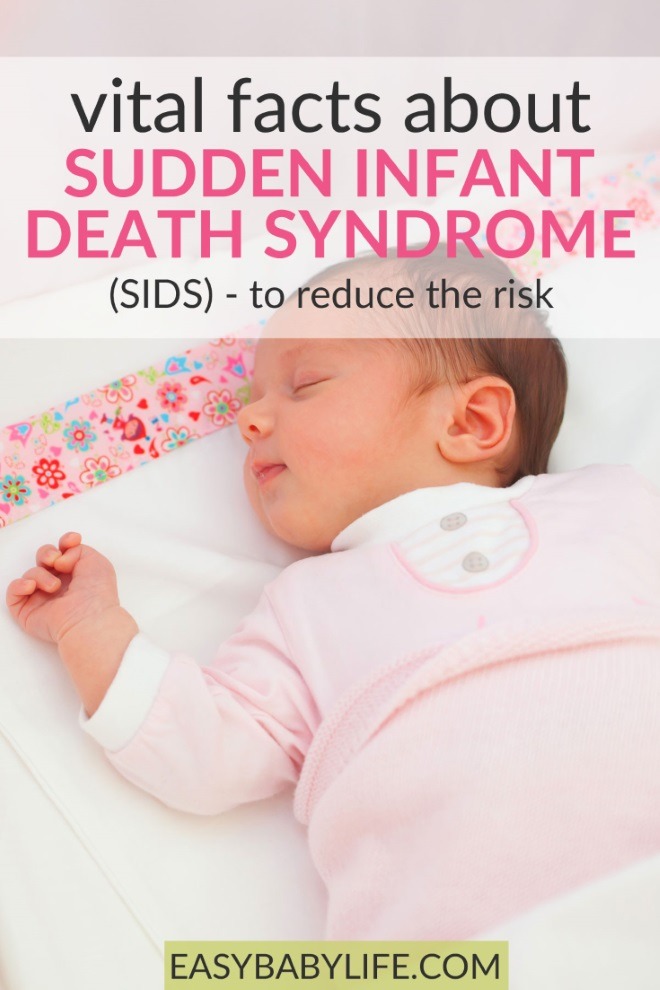
What is Sudden Baby Death Syndrome?
Sudden Infant Death Syndrome or SIDS – sometimes called crib decease or cot expiry – is the sudden and unexplained death of a seemingly healthy baby younger than one year old that normally happens during sleep.
Unfortunately, SIDS has no alert signs or symptoms.
Inquiry can still not explain why a baby stops breathing and dies suddenly similar this. Still, at that place are several theories and observations on variations between countries, gender, seasons, age, and more that may help you lot protect your child.
When using these metrics, if it seems that your baby may be at risk for SIDS, there are several precautionary steps you lot can take.
Read the article below and watch the video at the bottom of the article to learn about the take a chance factors and what protective measures y'all can take. Beneath the video, you'll discover the link to more than data on how to create a safe sleeping surroundings for your baby.
Sudden Infant Death Syndrome Facts and Take chances Factors
Unfortunately, SIDS remains mostly unexplained. Although we know what some of the master risk factors are and what to do to lower their impact or avert them, for many factors, there is still no clear show to explain why exactly they are high risk (e.g., gender).
Physical Factors
Some babies are more than likely to die of SIDS if, when they are built-in, the portion of their brain that controls breathing and arousal from slumber isn't mature enough.
Information technology has been shown that many infants who died of SIDS had had a common cold in the weeks before death. Therefore, a respiratory infection may take contributed to the breathing bug.
Cultural Variations
SIDS happens in families of all social, economic, and ethnic groups. However, it has been shown that the incidence of SIDS varies depending on the state and ethnic groups. A high incidence has been noted in, for instance, New Zealand, while Asia, the netherlands, Sweden, and Finland have particularly few cases of Sudden Baby Expiry Syndrome.
Within the U.s.a., African American babies are twice as likely to dice from SIDS than white babies, and American Indian babies are nearly 3 times more likely to dice of SIDS than white babies.
The reasons for these differences are still not clear. However, it is suggested that several factors may play a function, such as behavioral, sociodemographic, and environmental.
It is of import to note that the differences between countries accept fallen since the general advice to permit babies sleep on their backs was issued.
Gender and Age
Sudden Infant Death Syndrome is very uncommon for babies younger than ane month. It is most common when babies are 2-4 four months old, which is besides when the babe'southward brain undergoes dramatic neurodevelopmental changes. After that menstruum, the risk decreases. Only 20% of all cases occur when the baby is older than 6 months.
In that location are too gender differences in SIDS, with sixty% of all affected babies existence boys. As previously mentioned, SIDS is multi-factorial and probably happens as a combination of internal and environmental factors. Considering of it, researchers withal don't have all the answers to why baby boys are more susceptible to SIDS than infant girls. One of the possible explanations may be found in the fact that baby boys have a college risk of being built-in premature and a greater risk of suffering from conditions that are related to premature birth, such as respiratory distress syndrome.
Premature babies and babies with a low nascency weight (less than 2500 gr, (5 pounds viii ounces)) are also at college risk of Sudden Infant Death Syndrome. Premature birth increases the likelihood that the baby's brain didn't mature completely. Because of it, premature babies may accept less control over automated processes, such as breathing.
Differences in time of the twenty-four hours, day of the calendar week, and season
It has been shown that most babies who dice of SIDS die at night and are found in the morn. However, SIDS expiry can occur during daytime sleeps also. According to some enquiry, placing infants on their side to sleep was more than observed amongst the daytime deaths.
SIDS is more than common during weekends, only it is not articulate why. Altered means of living, such as that the parents consume more alcohol, is a possible explanation.
Somewhat more cases occur during winter. The general conventionalities is that infections are more mutual during the colder months. In countries without these seasonal variations, Sudden Infant Decease Syndrome appears to be higher during the semesters, supporting the theory that infections may cause SIDS. Another possible explanation is that babies are more likely to be overdressed or put under heavier blankets during winter, which may cause them to overheat or end up with their heads covered past the blanket.
Back to Sleep
Decumbent sleeping position (on the stomach) is a pregnant risk factor for SIDS, and it should be avoided.
Information technology is unclear why placing the babe to slumber on their belly puts them at higher chance. However, there are several possible explanations, such as suffocation, the face-downwards position leading to oxygen impecuniousness which may result in hypoxia, rebreathing of carbon dioxide, reduced arousal response and increased waking thresholds, airway obstacle, and similar.
Babies who are placed on their side to sleep are also at a college risk of SIDS. I of the possible reasons is that this fashion of sleeping makes it more likely that the baby will curl over on their belly during sleep.
Since the recommendation to put babies on their backs to sleep for all sleep times was issued, the percent of infants placed on their backs to slumber has increased dramatically, and the rates of Sudden Infant Expiry Syndrome accept declined by more than 50% in some countries.
Other Sleep Environmental Factors
Many studies showed that bed-sharing increases the chance of SIDS. Therefore, AAP strongly advises against information technology and emphasizes that the safest sleeping practice is to take the baby sleep in the parents' bedchamber, near the parents' bed only on a separate surface designed for infants.
However, AAP recently adapted its slumber guidelines, acknowledging the fact that bed-sharing nonetheless happens. Polls point that up to 70% of all parents bring their babies and older children in their family bed at least occasionally. If you put your baby in your bed to sleep, make sure to do it in the safest way possible past following safe co-sleeping guidelines.
Babies put to sleep on soft mattresses or couches, and similar are at college hazard for SIDS. According to some studies, babies who are placed to slumber on a soft surface have a five times higher take chances of SIDS than those babies who sleep on a firm mattress.
Loose bedding besides puts the baby at high take a chance, as they may state on top of the infant and get in hard for them to breathe. AAP states that a large percentage of babies who die of SIDS are found with their head covered by bedding.
Overheating is some other factor that increases the baby's risk of SIDS. Research shows that when babies are overheated, they are more probable to go into a deep sleep from which it is hard for them to arouse.
Swaddling
The research is still unclear when it comes to the effects of swaddling on SIDS. Swaddling the baby may prevent them from rolling on their tummy, which may protect them from SIDS.
On the other hand, swaddling may put the babe at a higher risk for SIDS if the infant is swaddled subsequently they are already able to ringlet over by themselves because it prevents them from lifting their head and moving if they are at run a risk of suffocation. Therefore, it is recommended that the parents stop swaddling the baby as before long as the baby shows any signs of trying to roll over.
As well, in the instance of bed-sharing, swaddling is not recommended considering it can pb to overheating, which is proven to increase the risk of SIDS.
Other Ecology Factors
The more children in a family, the higher the run a risk of Sudden Infant Death Syndrome. The reason for this is unknown but may have to practise with either some factors during the pregnancy or the fact that the number of infections reaching the newborn infant increases with the number of children in the family.
If the baby is exposed to fume in the womb or is afterwards exposed to secondhand fume, they have a higher chance of SIDS. According to some studies, babies whose mothers smoked during pregnancy are three times more than likely to die of SIDS, and secondhand fume doubles a infant'southward hazard for SIDS. Information technology appears that the chemicals found in secondhand smoke affect the brain in ways that interfere with the encephalon'southward regulation of an infant'south breathing.
Some research as well showed that babies who died of SIDS had higher nicotine levels in their lungs and cotinine, which is a biological marker for secondhand smoke, than infants who died of other causes.
Babies whose mothers use drugs or alcohol are besides at a greater risk of SIDS.
What is the departure between SIDS and SUID?
Sudden Unexpected Baby Decease (SUID) is the sudden and unexpected decease of a baby less than 1 twelvemonth old in which the cause was not obvious before investigation. It is a wide term that encompasses all sudden baby deaths, including accidental deaths (such equally suffocation and entrapment), sudden natural deaths (e.g., related to infection, ingestion, metabolic diseases, cardiac arrhythmias, etc.), trauma, or SIDS.
SIDS is one of several causes of SUID. Notwithstanding, unlike other causes of SUID, SIDS is given as a diagnosis merely later on all the other possible causes of sudden, unexplained decease take been excluded (later on a full investigation that includes an autopsy, death scene examination, and review of the clinical history).
Can a Baby Survive Sudden Baby Expiry Syndrome?
A common question to ask is whether a baby can survive SIDS. However, since SIDS is diagnosed only after expiry and by excluding other causes of expiry, information technology is not maybe to actually survive SIDS. And so, even if the respond to this question may seem horrific, the reason for the no, is when SIDS is really diagnosed (after death and after all other causes accept been excluded).
How to Reduce the Adventure of SIDS?
There are several important things you can do to lower the risk of SIDS.
Every bit mentioned above, y'all should always place your baby on their back to sleep—for naps and at night. Once your baby is able to roll over both ways without help, you don't accept to place them on their back for sleep anymore, and yous tin let them choose their own sleeping position.
Place your babe to slumber on a business firm mattress that maintains its shape. Information technology is also essential that you never sleep with your baby on the armchair, couch, or sofa. These pose a great risk for the baby's safety and significantly increase the risk of infant decease, including SIDS and suffocation due to entrapment.
Go along the crib as bare as possible. Remove any loose bedding, bumpers, nursing pillows, stuffed animals, or any soft objects from your baby's crib. Your infant's crib needs only a tight-fitted sail.
Continue your baby in your bedroom, most your bed, only place them to slumber on their own sleep surface, such as a crib or a bassinet. Research indicates that room-sharing without bed-sharing lowers the take chances of SIDS by as much as 50%. Yet, if you decide to bed-share occasionally, follow the guidelines that teach you how to do it in the safest manner possible.
Avoid overheating your baby by maintaining a comfy temperature in a room where your baby is sleeping and past dressing them warm just not too warm. Y'all can also consider using a slumber sack.
Don't fume during pregnancy, and avert smoking around your baby. Also, make sure that no i else smokes effectually your babe.
Breastfeeding has been shown to lower the take a chance of SIDS by equally much as 50%, so it is appropriate to breastfeed equally long as possible.
Consider using a pacifier considering information technology has been shown that putting your infant to sleep with a pacifier may lower the risk of SIDS, although it is still not known why. However, it is recommended to expect until your baby is breastfeeding regularly (if you're breastfeeding) before introducing the pacifier, and so it doesn't lead to nipple confusion. If your baby refuses a pacifier, don't force it. If your babe falls asleep with a pacifier in their rima oris but spits it out during sleeping, don't put information technology back in their rima oris while they are asleep.
Information technology feels practiced to end this page on a positive note. I retrieve it's wonderful that something as elementary every bit having your baby sleep on their dorsum can make such a big difference in the risk of SIDS. Also, many doctors believe that the relatively new recommendation of using a pacifier is probable to lower the risk quite a lot further.
If yous are truly worried most Sudden Baby Death Syndrome, there are very advanced babe monitors bachelor. Ane of the best is Owlet's baby monitor, with surveillance of a baby'due south breathing and heart rate. (Opens in new window). It is very expensive, though, so you might want to cheque out other options too.Even so, if you deci de to use them, do thorough research on the product yous're buying. Information technology is as well important to mention that such devices sometimes give parents a misguided sense of security.
For more help on how to protect your infant from SIDS, read this commodity on how to provide a safety sleeping surround for your baby.
And if y'all are worried that your infant will, for instance, get a flat head from all the dorsum-sleeping – read this article about common worries that parents have when information technology comes to placing their babies on their backs to sleep, such every bit a flat head, choking and similar.
Video On Sudden Infant Expiry Syndrome
Retrieve this to reduce the run a risk of Sudden Infant Death Syndrome :
- Allow your infant slumber on his dorsum
- Permit him sleep on a firm mattress
- Exist conscientious with blankets and stuffed animals
- Never smoke around your baby
- Don't smoke during pregnancy
- Introduce a pacifier
- Make sure your baby is not besides warm while asleep
- Breastfeed if possible
References
American Academy of Pediatrics. (2016). SIDS and other sleep-related baby deaths: Updated 2016 recommendations for a safe infant sleep environment. Pediatrics,138(5). https://doi.org/10.1542/peds.2016-2938
American SIDS Institute. (northward.d.). What is SIDS/SUID?
Blair, P. S., Ward Platt, Thousand., Smith, I. J., Fleming, P. J. & the CESDI SUDI Research Grouping. (2006). Sudden Baby Death Syndrome and the time of death: factors associated with night-time and daytime deaths. International Journal of Epidemiology, 35(6), 1563-1569. https://doi.org/10.1093/ije/dyl212
Boston Children's Hospital. (n.d.). Sudden Infant Expiry Syndrome (SIDS): Symptoms and causes.
Centers for Affliction Control and Prevention. (n.d.). About SUID and SIDS. https://www.cdc.gov/sids/about/index.htm
Centers for Disease Control and Prevention. (due north.d.). Wellness effects of secondhand fume.
Duncan, J. R. & Byard, R. W. (2018). Sudden infant death syndrome: An overview. In J. R. Duncan & R. Westward. Byard (Eds.), SIDS Sudden Babe and Early Childhood Death: The Past, the Nowadays and the Time to come. Adelaide (AU): University of Adelaide Press.
Good for you Children.org. (2020, Baronial 17). Swaddling: Is it safe? https://www.healthychildren.org/English language/ages-stages/baby/diapers-vesture/Pages/Swaddling-Is-it-Safe.aspx
Hobson, Thou. (2017, May 15). Racial and ethnic disparities persist in sudden infant deaths. NPR. https://world wide web.npr.org/sections/health-shots/2017/05/15/528173372/racial-and-ethnic-disparities-persist-in-sudden-baby-deaths
Mayo Clinic. (northward.d.). Sudden infant death syndrome (SIDS). https://www.mayoclinic.org/diseases-conditions/sudden-infant-decease-syndrome/symptoms-causes/syc-20352800
New Parent Support. (2018, September). Swaddling a baby: the benefits, risks and vii safety tips.
Safe to Sleep. (n.d.). Common SIDS and SUID terms and definitions. https://safetosleep.nichd.nih.gov/safesleepbasics/SIDS/Mutual
Safe to Sleep. (due north.d.). Research on other SIDS hazard factors.
University of Southern California. (2008, March 25). Babe boys are more likely to die than baby girls. Science Daily. https://world wide web.sciencedaily.com/releases/2008/03/080324173552.htm
Source: https://www.easybabylife.com/sids.html
0 Response to "How Long Is a Baby at Risk for Sids"
Postar um comentário